NY Times: "Marketers are going beyond the visual to take more interest in the aural aspect of brands, often referred to as "the sound of brand."
Sound-branding extends beyond traditional efforts like jingles in radio or television advertising, which can be perceived as too commercialized. Intel, for instance, may be better known for its "Intel inside" musical signature than for its microchips. Retailers like Gap, Starbucks and Williams-Sonoma sell millions of CD's each year that offer shoppers customized compilations of songs meant to complement corporate brand images." (via
Social Marketing)
More:
An older article on Brand Channel about sonic branding.
Boom Sonic Branding provides services.
So does Audio Brain, as well as DMI Music & Media Solutions, Creative Sonics, Sonicsista (who did the T-Mobile ringtone), and Audio Brain.
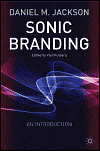
There's a whole book called Sonic Branding if you want to know more.
Update [June 12, 2006] - our reader Lucas von Gwinner writes:
"I'm quite sure that the T-Mobile Acoustic Logo wasn't developed by Sonicsista. It was developed by Chris McHale from McHaleIP (New York) with the support of Interbrand Zintzmeyer&Lux in Cologne, Germany. What I don't know is, how far Lisa Lamb, who was at Interbrand London at this time, was involved in the project."
Hey, Sonicsista claims on its website that "our work with them [T-Mobile] included the now-famous T-Mobile ringtone."
Update [June 20, 2006] - Lisa Lamb responds:
"The original acoustic logo was written by Chris McHale and is a piece of Strauss played backwards to emphasise the pink dots and large T of the T-Mobile graphic logo. During this time I was head of sonic branding at Interbrand in London. This was used as a sign off in a few TV and radio adverts when it was first written and also incorporated into some longer pieces of music although these were not generally used. However, following this, Sonicsista was employed by T-Mobile as their principle sonic agency to create sonic strategy and other sound assets, and from the strategy we created for them, we turned this into a series of ringtones and functional sounds. Hope this clears up the confusion!"
Update [January 6, 2009] - Lance Massey writes:
I just came across [this blog post] saying that the T-Mobile ring tone was composed by Chris McHale. It wasn't. It was composed by me while working as a staff composer at mcHale Barone. Also, Lisa Lamb says that it's a bit of Straus played backwards. That is also not true. It simply popped into my head, and I later quipped that it looked like the opening of Beethoven's Fifth played upside down.
Update [February 10, 2009] - Lisa Lamb responds:
Sonicsista became aware of Lance Massey's alleged involvement in the TMobile ringtone composition after our original post on this forum in 2006. He emailed us with an anonymous quiz about the composer of the sonic logo. We gave the same answer as we did here which was, to the best of our knowledge, true. We had been given this information, and the backwards Strauss anecdote by the CEO of Interbrand, Frankfurt who was the branding company retained by TMobile and also the company responsible for subcontracting McHaleIP, whom Lance claims to have worked for while he composed that piece. He also, we note, on his Linked In profile, claims to have worked at Interbrand during that period, not McHaleIP so what is at the bottom of this conundrum we may never know. I was Head of Sonic Branding at Interbrand from 1999-2001 and I certainly never heard of him. No matter.
We may never know who wrote exactly what exactly when or exactly what they were thinking. I'm not sure that this is exactly relevant. Perhaps Lance is the composer of the tune, perhaps he is not, I have no idea. Ultimately it doesn't really matter. The TMobile sonicID is a great piece of sonic branding and as anyone who has absorbed anything about the topic should know, great sonic branding is about so much more than a catchy tune.
Update: [January 6, 2010] Lanse Masey responds:
My involvement is not "alleged" -- it's a fact. I was on staff at McHaleBarone (Chris later bought out Joe and renamed the company to McHaleIP). And I can tell you who did exactly what:
The original piece for Deutsche Telekom was called "Hello Ola" and was to be used as the theme for the T-Mobile Tour de France bicycle team.
Chris McHale came up with the concepts of music expressing the sound and feelings of data packets carrying voices around the world. Tim Leitner engineered. Joe Barone co-produced. Mike Harvey created the vocal parts and melody ( most brilliant singer I've ever worked with BTW ).
And I composed the basic tracks and those 5 notes...
In the beginning: the T-Mobile graphic logo was to be mutable (that is it could be any number of gray squares followed by a pink T followed by any number of gray squares). So, I created a simple algorithm for the audio logo to follow the same scheme with middle C being a gray square, and the major third being the pink T. It simply happens to have come to pass that the world settled on the 3 gray squares, followed by a single pink T and ending with a single gray square (da-da-da-dee-dah).
(Something people don't know is that there is also a pedal G underneath it all. It makes a huge difference to the feel...)
The algorithm was constructed so that if the visual logo and audio logo were synchronized it would stick immediately, and permanently, in a person's memory (see my work at neuropop.com). Sadly, the agencies didn't follow that particular direction, so it took some serious media buying to get it to stick -- but stick it has. :)
Whether Lisa ever heard of me or not is simply a matter of overlooked paperwork...
***
Earlier:
Marketers Should Create Multisensory Campaigns
Ringtone Advertising - Check
 Keywords: sonic branding, audio branding, sound branding, aural branding.


