Mannequin Crowd Promotes Real Estate


An outdoor installation of 100 mannequins dressed in branded t-shirts promotes new condominium residences in Atlanta. See the very cool images and videos here. Highly awesome!
-- thank you, Lori

Advertising Lab Turns Two


Today AdLab turned two. Many thanks to you all without whom any of this would make little sense. Thanks for reading, for writing, and for linking back. Your words of encouragement keep this thing going, and being picked by Comm Arts as one of the 50 essential bookmarks was a great morale boost, too. Special thanks to Future Lab who were the blog's first advertisers, and to everyone who syndicates AdLab elsewhere: FutureLab again, The AdFeed, Ogilvy PR. And, of course, blogging wouldn't be possible without the stimulating environments at MIT CMS where it started and Hill Holliday where it continues.

If you are reading the blog exclusively through an RSS reader, come take a look at the new, uh, look of the site. If you want to add a link to the "Readers' Links" section, tag the page at del.icio.us with "2adverlab".

How did the blog do this past year compared to the last birthday's stats? Let's see:

  • Posts published: ~ 700 (same as year ago)
  • Total page views: ~580,232 (up from ~130,000)
  • FeedBurner subscribers: ~ 1,200 (up from 200 last November)
  • AdSense ad revenue: ~ $5,000 yearly total (up from ~$1,000)
  • Technorati back links: ~ 3,286 (up from 150). Rank ~3,000. Blogs linking back: ~600
  • Google PageRank: 6 (no change)
Traffic, all time:


FeedBurner RSS subscribers, all time:

Second Life Shorts


Not these shorts, though. Here's what we have to report.

-- Second Life apparently preps a roll-out into Asia and hires a PR agency Lewis, writes Brand Republic.

-- It also writes that Bartle Bogle Hegarty's offices "became the victim of a Second Life flash mob, who turned up sporting strap-on dildos and simulating various sex acts."

-- Second Life Herald fumes (not safely for work) over advertisers claiming in-world firsts: "It is a case of a bunch of desperate clueless fucktards trying to show how bleeding-edgy they are, and, given that SL is the bleeding-edgy flavor of the month, they are wraping themselves in the Linden cape of bleeding-edginess."

-- Crackunit.com suggests, "Why aren't advertisers, or people who are trying to 'import' brands from their First Life forced to wear some kind of huge advertising helmet? It'd protect them from rocks thrown by irate Second Lifers as well as marking them out as advertisers."

-- Catherine Smith, marketing director at Linden Lab, offers a piece of advice: "Keep it fresh, build the foundation and let your customers join in creating the experience, keep them involved, offer social context (discussions, parties, games, etc.), create connections to the real world - website, content uploads, social tools for connecting and sharing successes."

-- Here's a June paper from Universal McCann "Parallel Worlds" (list; direct link to pdf). A very interesting tidbit: "Second Life and World of Warcraft are currently working together to form a cross-genre community MMOG, SLoW. It's certainly a risk and is expected to take close to two years to build; the combination will allow hybrid interaction in a world of blended niches. This will be an exciting opportunity for marketers to test out new marketing techniques in an "otherworld" while breaking down the barrier of the fantasy genre." Never heard of this; will be interesting to confirm.

Update (Nov 10, 06): Tony Walsh points out that SLoW is not an official project.

-- Information Week: "Residents are looking for real-world money by setting up stores powered by Amazon.com. Since July, at least three retail projects have been launched in Second Life to sell books, music, kitchenware, electronics, and other items in the online retailer's catalog."

-- New brands in SL: Scion that can be modded by residents, a tabloid (coming soon, claims it's first), a British radio (it, too, says it's first).

Advertise on M&Ms


You already can order M&Ms customized with your name, but now the candies are becoming a real ad medium. MediaPost writes: "MasterFoods will go from being a media buyer to a media seller, offering other marketers a chance to place their corporate and consumer brands, logos and other messages on M&Ms chocolate candies. The new offering, dubbed "My M&Ms My Branding," includes brand placement on up to 17 of the 22 colors M&M offers."

Technorati: Blogosphere Growth Slows


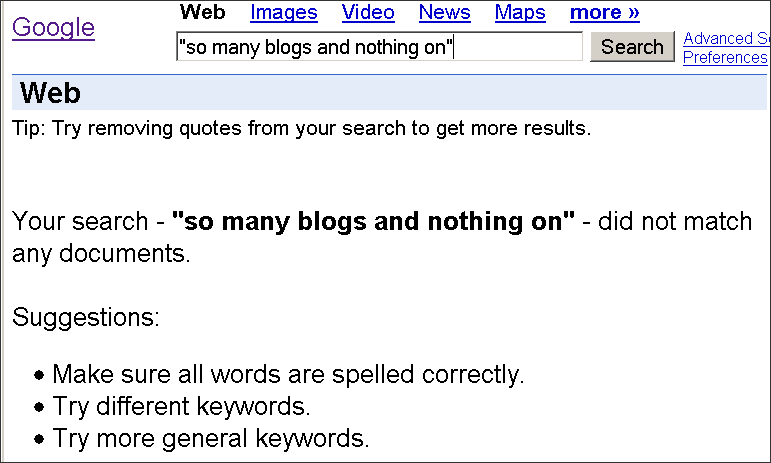
David Sifry brings fresh numbers on the state of the blogosphere. Lots of graphs. The big news: "the doubling of the blogosphere has slowed a bit." On the other hand, Sifry says Technorati has become better at weeding out splogs, which, I think, means the number of "real" blogs is actually growing faster. The big number: 57 million. So many blogs and nothing on.™ Here. I've just said something unique.

Holographic Advertising 3D Displays by Holo FX


"AURA is a 3D holographic display medium designed for life-sized presentations. With its realistic human format, it can draw consumers close to a featured product exhibit." The company, Holo FX, claims it has "developed a line of exciting and innovative 3-D holographic display media for use in the advertising and display industries." Fairly new; the company was mentioned in July's Creative Online Weekly.

If you are into this stuff, check out Dimensional Studios who sell 3-D screens and large Pepper Ghost installations (like the one used to project Kate Moss into a glass pyramid). Use the search box below for more; I posted a lot about 3D displays last year.

Fortune on Personal Fabricators

Fortune writes about MIT's Neil Gershenfeld and his work at Center for Bits and Atoms: "Today your all-in-one device prints, scans, faxes and copies. Tomorrow it will cut, score, etch and sew. Want a new dining room chair? You'll design it on a PC and press PRINT, and your personal fabricator will create it for you right before your eyes. Just make sure tray No. 2 has enough wood." (via Make)

If you want to know more, check out Gershenfeld's recent book FAB. Rebang often writes about fabrication; here's a recent post about a shoe fabricated using a technology associated with rapid prototyping. Fabjectory is one company that prints out 3D objects from virtual worlds (games or Google Earth, for example) data: avatars, weapons, dragons. Here's a pic of some of their creations (more on Flickr).


What does this have to do with advertising? Here's a bit from an essay draft I wrote for Convergence Culture last month.

"The advances in technology, even that that is not ostensibly related to advertising but especially the technology of production and distribution of goods, will greatly influence the way these goods are advertised and here's one example. Yesterday, you would see an ad for a chair and head to the store to buy it. Today, you type in the store's URL, pay with a card and receive it in the mail in a few days. Tomorrow, you may be able to print the chair out on a 3-D printer that today is used for rapid prototyping of architectural and engineering models. The gratification will be truly instant as the time gap between seeing the ad and coming into possession of the goods disappears. How will instant manufacturing affect advertising practices? We can speculate that the ads for individual products will have to become more detailed, for example, if customers are to give up the comfort of having the opinions of friends and of having an opportunity to try the product in the store.

With the nature of merchandise reduced to a bucket of polymer dust and molding instructions, it is likely that chair manufacturers will face the problem well familiar to RIAA and MPAA. Once chairs and other things become content, the prospect of rampant chair piracy turns from unimaginable into very real.

The conversion of merchandise from contained and scarce atoms into ubiquitous bits, the idea described by Nicholas Negroponte in Being Digital, will present marketers with another dilemma. Brands in their essence are meta-data that describe the ephemeral qualities of a physical product. Without these meta-data, the chair I am sitting on is just that, a chair. It’s black, has two adjustable arm-rests, it swivels, rotates and rolls when pushed. The Ikea label on it adds a data layer on the top of its intrinsic descriptors. Now it's a chair that has been created by a certain designer in Sweden, it has a name, and its perceived value will vary depending on whether the society has agreed that Ikea's furniture is stylish and hip or cheap and not very durable.

Advertising has traditionally focused on adding meta-layers to such physical products, from Burma Shave creams to Gillette five-blade razors, but it has yet to learn how to attach these layers to the products that are data themselves. The relative decline of importance of recording labels coincided with the digitalization of music that has unbundled and disembodied the product that was once incased in brandable vinyl, magnetic tape or CD plastic. The label loses its meaning when you cherry-pick the product parts and then mash them up with other bits to create a unique product whose only true brand is you. What happens to the music bits today will happen to the chair bits tomorrow when you are able to download the arm-rests from Ikea and the upholstery from Crate & Barrel, mix them up and print them out."

Microsoft Launches Virtual Earth with Billboards


click image to zoom

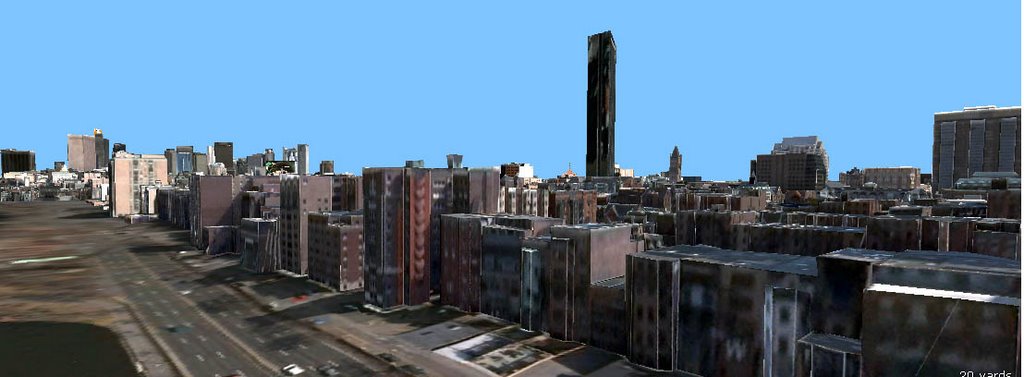
Microsoft launched Virtual Earth, an online 3D application that's part of the company's mapping site, and the first 15 cities shown in their full three-dimensional glory are peppered with billboards. The maps are displayed in the browser unlike its stand-alone Google Earth competitor, but you do need an Internet Explorer (no Firefox), a couple of hefty plug-ins, .NET 2.0, and a fairly powerful computer. Apparently, the floating billboards that look a lot like what you'd see in Second Life, are served through the Massive technology Microsoft acquired in May.

ClickZ writes: "Launch advertisers include Fox's theatrical division, Zip Realty, Nissan, and John L. Scott. The experience is the culmination of technologies from Virtual Earth, Microsoft's Massive in-game ad division and its Digital Advertising Solutions' platform."

The ads are flat (that is, you don't see much if you are viewing them sidewise) and clickable. A click opens a new browser window with the advertiser's website.

CNet has more details about the project: "Microsoft also is opening up the application programming interface for Virtual Earth 3D to allow developers to build the search features into their own applications and Web sites."

Here are some pictures of 3-D Boston:


An ad for Zip Realty. You'll find the same one in Seattle, with Seattle's name on it.


A dramatic vista that looks like a computer game.


Very nice texturing work. That's Trinity Church on Copley Sq. (compare to real photographs) and the Hancock Tower. If you look closely, you'll see me on the 41st floor waving at the satellite.

Also, read these earlier posts:
Google Earth Becoming Virtual World
Google Earth Runs AdWords
Google Earth Compatible With Other 3D Environments
Google Earth Becoming Advertising Tool

P&G Creates Virtual Reality Research Room

Research magazine (could go behind the subscription wall soon): "Procter & Gamble has created a new research facility [in Britain] which uses computer-generated imagery to re-create shops. Research participants enter the room, known as 'The Cave' and walk through the simulated store, looking at different displays, 'picking up' products to look more closely, and choosing to 'buy' the ones they like. Opened in July at P&G's offices in Weybridge, Surrey, 'The Cave' is used to test shoppers' reactions to store layouts, shelving, and product and packaging design. Eighteen projects are already underway with retailers including Tesco, Sainsbury, Asda and Boots, mostly in the beauty area where the shopping environment has a big effect on sales." The magazine also has a whole feature called Virtual Zone, but I don't think I'm subscribed to see it.
-- via msurveys

Earlier:

Game-like 3D Environment For Modeling Outdoor Campaigns

Analysis of Political Paid Search Ads


The Rimm-Kaufman Group published an analysis of a handful of political ads that appeared in search engines (mostly Google). Some of the findings: the blues were more negative than the reds but the reds were more numerous, no ad referenced Bush, only two ads linked to videos. The observation I liked the most: "Blue ads were more likely to include an exclamation point. Red ads were more likely to contain a question mark."

There is something haiku about packing powerful political proclamations into the puny 90 characters of an AdWords blurb.
-- thank you, Alan